
Reviewed · WEAVING AND HANDICRAFT WORKSHOPS
Luang Prabang: Bamboo Weaving Workshop & Cooking Class
Bamboo becomes the star of this Lao half-day outing. Beyond the usual temples and caves, you get a hands-on look at how one plant supports daily life, from fishing tools and household goods to musical instruments and food. I especially like the patient weaving lesson and the chance to cook with bamboo shoots over a real fire. The garden setting, local hosts, and traditional meal give the activity a friendly, personal feel.
The main drawback is the price: $44 per person is not the cheapest half-day activity in Luang Prabang. You should also know that the rustic setting may not suit people with mobility impairments, wheelchair users, or pregnant women. Still, for anyone seeking culture with less sitting and more doing, this is a strong choice.
In This Review
- Key points at a glance
- A quiet start outside Luang Prabang
- Why bamboo matters in Lao daily life
- Making a mat from raw bamboo strips
- Cooking bamboo shoots over a real fire
- Music, dancing, and the human side of the visit
- How much value do you get for $44?
- Morning or evening: choose with care
- Who will enjoy this activity most?
- What I would improve
- Should you book it?
- FAQ
- How long does the bamboo weaving and cooking class last?
- What time does the morning session begin?
- What time does the evening session begin?
- Is hotel transportation included?
- What food will I help prepare?
- Is a meal included?
- Are alcoholic drinks included?
- What should I bring?
- Who should not take this activity?
Key points at a glance
- You make a bamboo souvenir: Learn to sharpen knives, cut bamboo into strips, and weave a small mat or coaster.
- Bamboo runs through the meal: Help prepare bamboo shoot soup, bamboo shoot steamed in banana leaf, bamboo shoot dip, and other local dishes.
- The setting feels genuinely local: A traditional bamboo house and pavilion sit among greenery and rice fields outside Luang Prabang.
- Music adds a welcome finish: Local Lao musicians demonstrate bamboo instruments, and some sessions include bamboo dancing.
- Morning and evening feel different: Choose morning for better photos, or evening if you want to prepare your own dinner.
- The experience is run locally: The activity is operated by Lao people, with English-speaking instruction and hotel transport included.
A quiet start outside Luang Prabang
Your day begins with hotel pickup by tuk-tuk, around 8:30 AM for the morning session or 4:00 PM for the evening session. You need to wait in your hotel lobby five minutes before pickup. The ride takes you away from central Luang Prabang toward a rustic pavilion modeled on a traditional Lao house.
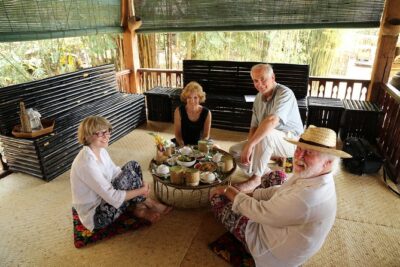
The setting is a major part of the appeal. You might look out over rice fields, bamboo, and lush greenery while the class unfolds. This is not a polished cooking studio designed to feel like a restaurant kitchen. It is a more relaxed place where the building, tools, ingredients, and surrounding plants all help explain rural Lao life.
A warm welcome and a drink begin the visit. Some versions of the experience have included a short local market visit, though you should confirm this when booking because the core activity is the bamboo workshop and cooking class. The hosts may also add cultural elements depending on the session, such as music, dancing, or a baci ceremony.
The group size is not specified, so the feel can vary. Several people have found themselves in very small groups or even alone, which allows for plenty of personal help. You should not book on the assumption that every session will be private, but a small group would make the weaving and cooking easier to follow.
More Cooking Classes in Luang Prabang:
- Luang Prabang: Evening Cooking Class & Local Baci Ceremony
★ 4.9 · 151 reviews - Luang Prabang: Cooking Class at the Former Royal Palace
★ 4.9 · 51 reviews - Day-time Bamboo weaving & Cooking Classes join-in
★ 5.0 · 38 reviews
Why bamboo matters in Lao daily life
The first lesson explains why bamboo is far more than a decorative plant in Laos. The instructor shows how it can become fishing tools, household items, building materials, baskets, musical instruments, and cooking equipment.
This introduction gives the rest of the activity a clear purpose. You are not simply making a craft and then preparing lunch. You see how the same plant connects home life, work, food, and music. The lesson also helps you notice bamboo differently during the rest of your time in Laos.
The hosts use physical examples rather than relying only on talk. Items can be passed around and explained, making the session easy to follow even if you know little about Lao culture. English is the working language, and the instructors are described as friendly, clear, and entertaining.
The best teaching seems to come from the people who turn ordinary materials into useful objects. Some sessions have featured a bamboo weaving master, while guides such as John and Sia have been praised for giving clear instruction and adding humor. Staff can change, but the activity is built around local people showing you their own skills.
Making a mat from raw bamboo strips
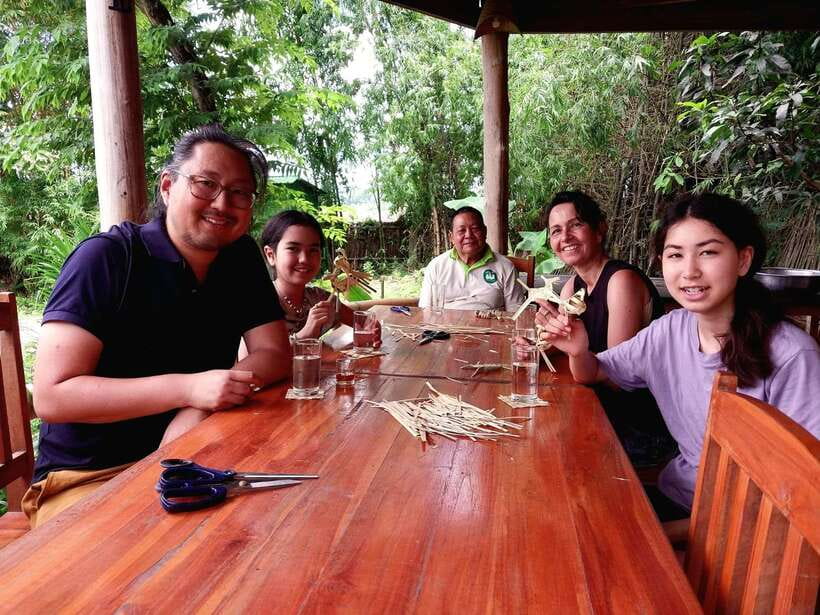
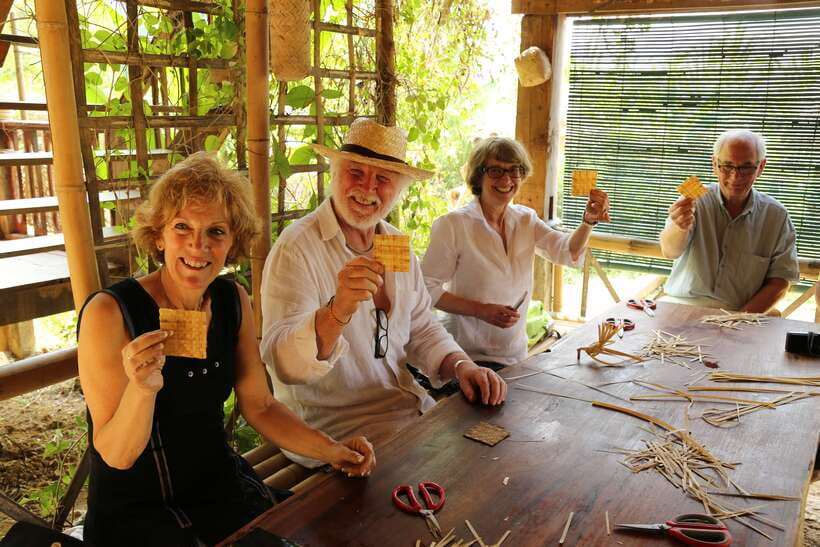
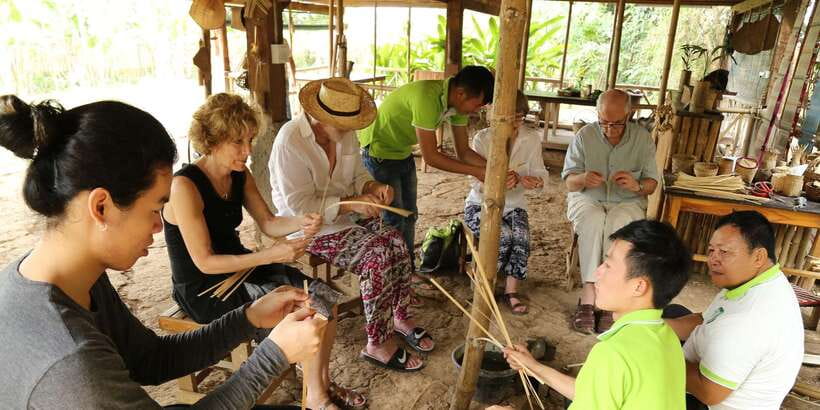
The weaving workshop is the most tactile part of the visit. You learn how to sharpen a knife and cut bamboo into narrow strips before arranging them in an overlapping pattern.
Do not expect to produce a large or perfectly finished basket in a few minutes. The project is a small souvenir mat or coaster, and the value is in learning the method. Bamboo strips can be awkward at first, especially when your pattern begins to loosen or the edges stop lining up. A patient instructor stays nearby to correct mistakes and show you how the strips should pass over and under one another.
I like this part because it gives you a real sense of the labor behind objects that often look simple in a market. The final piece may be modest, but you have handled the material from the beginning rather than buying a ready-made souvenir.
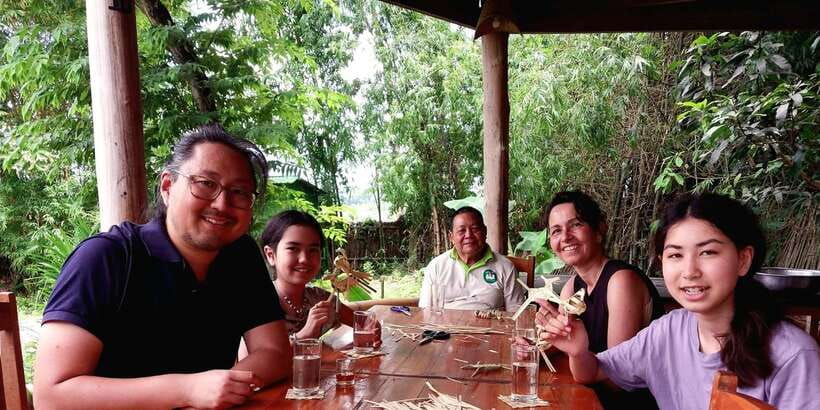
You should wear comfortable clothing and shoes. The process involves knives and natural bamboo strips, so this is not the place for a rushed outfit or delicate clothing. Children can enjoy the activity with help, though adults should expect to supervise younger children around sharp tools.
One family found the staff especially helpful with their young daughter, giving the adults more time to focus. That suggests the setting can work well for families, but the activity is still hands-on and may not suit every child.
Cooking bamboo shoots over a real fire
After weaving, the focus shifts to Lao cuisine. Bamboo shoots become the central ingredient, giving you a direct link between the first lesson and the meal.
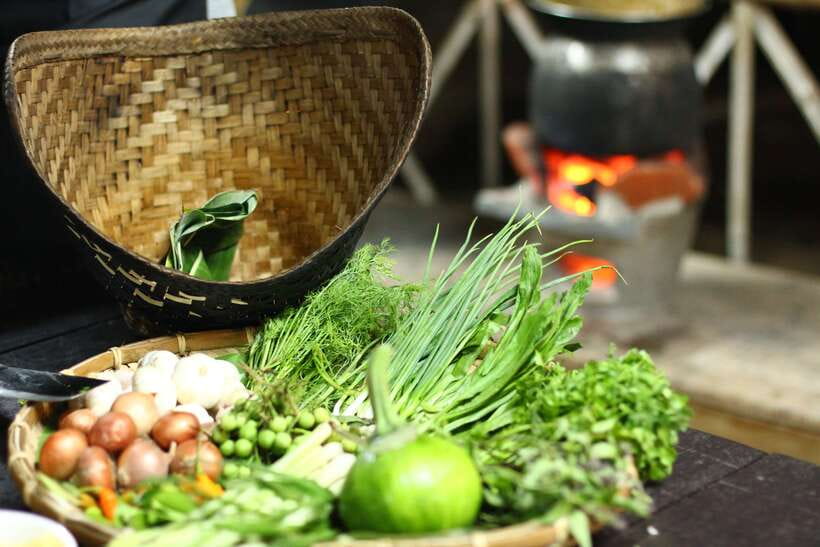
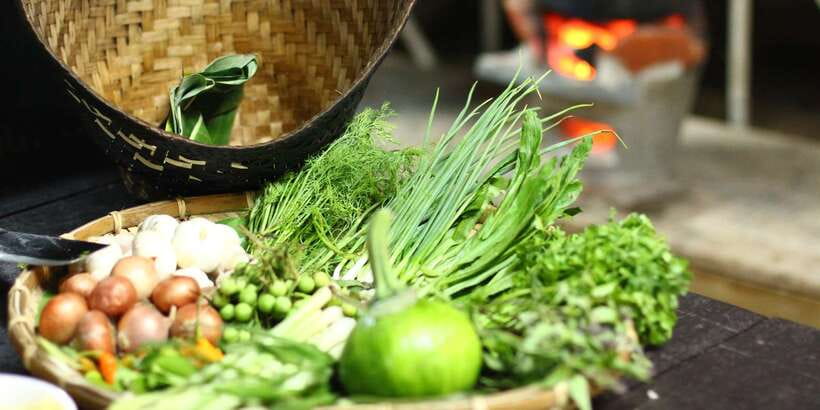
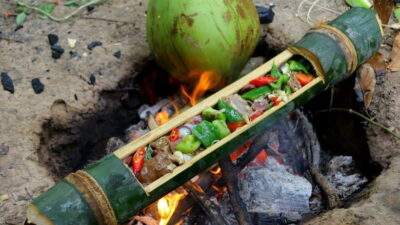
The menu can include bamboo shoot soup, bamboo shoot steamed in banana leaf, and bamboo shoot dip. Other dishes may feature meat or fish, and vegetarian food has been available in past sessions. The exact menu can change, but the point is consistent: you help prepare food that uses local ingredients and traditional methods.
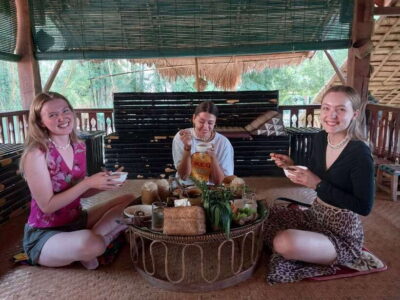
The cooking takes place in a garden setting, and some sessions use a real fire. That adds a little smoke, heat, and theater to the lesson. This is less like a formal demonstration where you stand back and watch, and more like a shared kitchen where you assist the chef with preparation and cooking.
Rice may be steamed in bamboo baskets, and bamboo shoots can be filled with a savory mixture before cooking. These details make the class more interesting than a standard lesson built around dishes you might already see in restaurants. You also learn how bamboo serves the meal itself, not just the ingredients.
The food is served after the activity on a traditional bamboo tray, either as lunch during the morning session or dinner during the evening session. The meal is included in the price, while alcoholic drinks are not.
The evening option has a practical advantage: you prepare your own dinner and eat it afterward. The morning visit is better for photographs, with daylight showing the bamboo house, garden, and rice fields more clearly. If you care most about atmosphere and the meal, choose evening. If you want photographs and a cooler start, choose morning.
More weaving and handicraft workshops:
- Luang Prabang: Bamboo Experience & Kuang Si Falls Tour
★ 5.0 · 38 reviews - Evening Bamboo weaving & Cooking classes join-in
★ 5.0 · 17 reviews - Luang Prabang Street Food Culture, Paper Handicraft Village Tour
★ 5.0 · 10 reviews - Luang Prabang: Weaving Workshop Half-Day Experience
★ 5.0 · 9 reviews
Music, dancing, and the human side of the visit
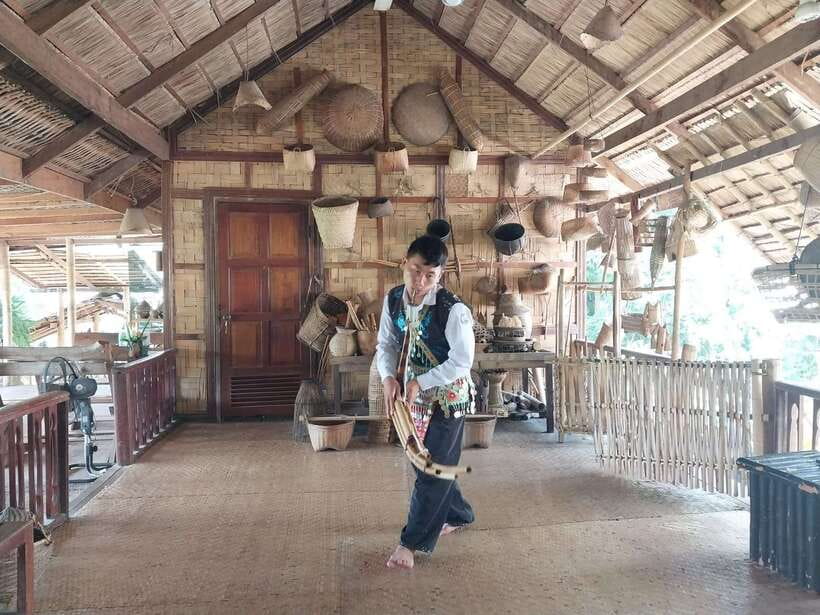
The cultural program often continues after the meal. Local Lao musicians demonstrate bamboo instruments, and you may get a chance to try one yourself. Some sessions also include bamboo dancing.
One past experience included a Hmong musician who performed traditional music and invited participants to have a turn. That small invitation changes the mood. You are not simply watching a staged show from a distance. You get a brief chance to handle the instruments and take part.
The dancing can be just as memorable, especially after everyone has spent time concentrating on knife work and weaving patterns. It gives the visit a light finish and creates room for conversation with the hosts.
The exact entertainment may vary by session, so treat it as a likely cultural addition rather than a guaranteed full performance. The core promises are the bamboo activity, cooking class, transport, instruction, and meal.
What stays consistent is the contact with local people. The experience is run by Lao staff, and the setting feels connected to a family and community way of life rather than a large tour operation. Several past participants have valued the kindness of the hosts as much as the activities themselves.
How much value do you get for $44?
At $44 per person, this is a mid-priced Luang Prabang activity. You can find cheaper meals and informal craft experiences, but this price includes hotel pickup and drop-off, an English-speaking instructor, the weaving activity, the cooking class, and lunch or dinner.
The value improves if you want several experiences in one outing. In four to five hours, you get cultural context, a practical craft, a cooking lesson, a full meal, transport, and possibly music or dancing. You also avoid arranging separate transport to the countryside.
The price may feel high if your main goal is simply to eat bamboo shoots or buy a small souvenir. It is also less appealing if you dislike organized instruction or would rather spend your time independently. You are paying for access to local skills, equipment, teaching, and a setting that would be difficult to arrange on your own.
I would consider it good value for a first visit to Laos, especially if you want an activity that explains everyday culture instead of focusing only on famous sights. It is also a smart choice after several days of temples, caves, and sightseeing. One person who had spent five weeks moving around Southeast Asia chose it specifically for something different and found the change worthwhile.
Morning or evening: choose with care
The two start times create different experiences:
- The morning session begins around 8:30 AM. Daylight is best for photographing the bamboo house, garden, rice fields, and finished craft. You receive lunch afterward.
- The evening session begins around 4:00 PM. You prepare dinner and eat it as part of the experience. The later light may give the setting a softer mood, though morning is specifically recommended for the best photo opportunities.
Both versions last about four to five hours and include hotel transfer. If you have a sunset cruise, market visit, or evening performance planned, the morning session leaves your night free. If you want to keep the hottest part of the day open and enjoy a dinner you helped make, choose evening.
Pickup timing matters. The operator asks you to wait in the lobby five minutes early, and a no-show or delay of more than 30 minutes can lead to cancellation without a refund. Build in a little time before the scheduled pickup, especially if your hotel is difficult for a tuk-tuk to reach.
Free cancellation is available up to 24 hours before the activity, and you can reserve now and pay later. Those terms are useful if your Luang Prabang plans are still shifting.
Who will enjoy this activity most?
This is a good fit if you like learning by doing. You should enjoy simple crafts, local food, informal conversation, and a setting outside the main town.
It suits solo visitors particularly well because the instructors can give close attention in a small group. Couples and families can also enjoy it, especially if everyone is happy to take part rather than simply watch.
It is a strong option for:
- People who want a break from temples and caves
- Visitors interested in Lao food and household traditions
- Anyone who likes taking home a handmade souvenir
- Families with older children who can follow safety instructions
- Visitors who want hotel transport included
- People who prefer a relaxed cultural activity over a busy sightseeing schedule
It may not be right for you if you need wheelchair access, have a mobility impairment, or are pregnant. The traditional bamboo house and hands-on work may present practical difficulties. Comfortable shoes and clothes are recommended, and pets, outside food, and drinks are not allowed.
What I would improve
The main weakness is not the quality of the activity, but the uncertainty that comes with a local, flexible format. The menu, cultural additions, and group size may vary. If you expect a fixed restaurant-style cooking lesson with an exact list of dishes, you may find the experience less predictable.
The activity is also longer than a quick workshop. Four to five hours is enough time to make the visit feel substantial, but it takes a half-day from your schedule. You should not squeeze it between tightly timed appointments.
The knife work and bamboo preparation require attention. That is part of the point, but it means the session is not completely passive or effortless. Wear clothes you can move in, listen carefully, and accept that your first woven pattern may need repair.
Finally, $44 is a real consideration for budget-minded visitors. I would pay it for the combination of transport, food, instruction, and cultural access, but I would not recommend it simply because it is the cheapest way to fill an afternoon. It earns its price through the personal teaching and the range of activities.
Should you book it?
I would book this experience if you want to understand how bamboo fits into Lao life and you prefer participation to sightseeing from a distance. The strongest parts are the patient weaving instruction, the bamboo-based meal, the beautiful rural setting, and the warmth of the local team.
Choose the morning if photos matter most, or the evening if cooking and dinner are your priority. Leave room in your schedule, wear comfortable clothes, and expect a rustic setting rather than a polished culinary school.
Skip it if you need wheelchair access, dislike craft work, or are looking only for a cheap meal. For everyone else, this is one of the more useful half-day choices in Luang Prabang because you leave with a small handmade object, a fuller stomach, and a clearer idea of how one humble plant supports Lao homes, work, food, and music.
FAQ
How long does the bamboo weaving and cooking class last?
The experience lasts about four to five hours.
What time does the morning session begin?
Hotel pickup for the morning session is around 8:30 AM. You should wait in your hotel lobby five minutes before pickup.
What time does the evening session begin?
The evening session begins around 4:00 PM, with pickup from your hotel included.
Is hotel transportation included?
Yes. Pickup and drop-off from Luang Prabang hotels are included.
What food will I help prepare?
The class can include bamboo shoot soup, bamboo shoot steamed in banana leaf, and bamboo shoot dip. Other dishes may include meat or fish, with vegetarian options available in past sessions.
Is a meal included?
Yes. Lunch is included with the morning session, and dinner is included with the evening session. The meal is served in a traditional bamboo tray.
Are alcoholic drinks included?
No. Alcoholic drinks are not included.
What should I bring?
Bring comfortable shoes and comfortable clothes.
Who should not take this activity?
The experience is not suitable for pregnant women, people with mobility impairments, or wheelchair users. Pets, outside food, and drinks are not allowed.
Just added in Luang Prabang
- The Namkhan – Traditional Lao Bamboo Weaving★ 5.0 · 4 reviews
- Unwind with a Sunset Cruise on the Mekong River★ 5.0 · 4 reviews
- Night Bus to Huay Xai, Chiang Rai, Thailand – Hotel pickup★ 3.0 · 2 reviews
- Sunset Cruise in Luang Prabang with Live Performance★ 4.5 · 3 reviews
- The Namkhan – 90 Minutes Private Signature Scrub and Massage★ 5.0 · 2 reviews
- Private Tour: Half-Day City Tour of Luang Prabang★ 4.5 · 4 reviews
- Trek to Tad Sae Waterfalls, Local Village★ 4.5 · 2 reviews
- Private Luang Prabang City Tour★ 5.0 · 3 reviews
Weaving and Handicraft Workshops, compared.
Day-time Bamboo weaving & Cooking Classes join-in
Read our review →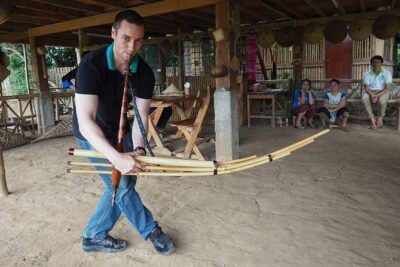
Evening Bamboo weaving & Cooking classes join-in
Read our review →
Luang Prabang Street Food Culture, Paper Handicraft Village Tour
Read our review →
Full Day bamboo experience with cooking class & Kuang si waterfalls
Read our review →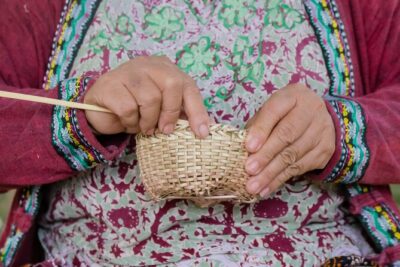
Browse the lists this tour appears in