
Reviewed · LUANG PRABANG TOURS
DIY Lao Knife Workshop
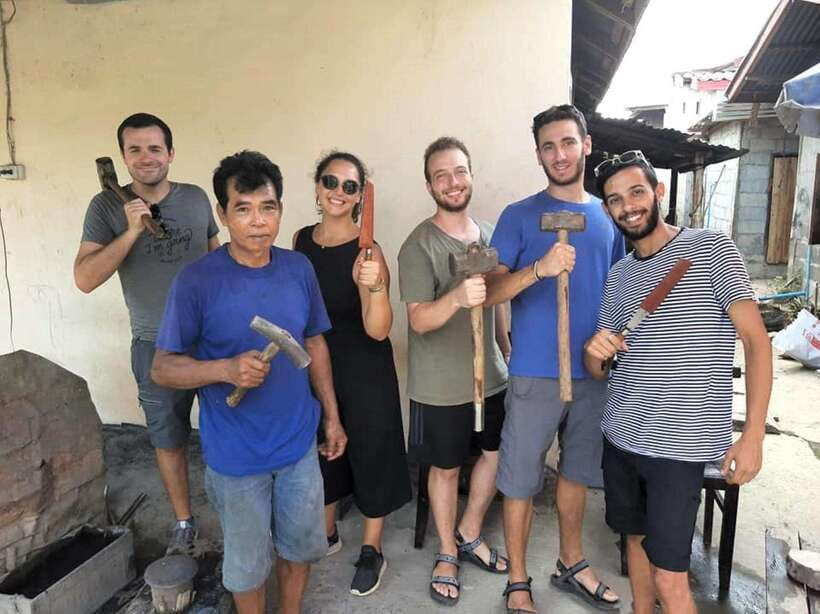
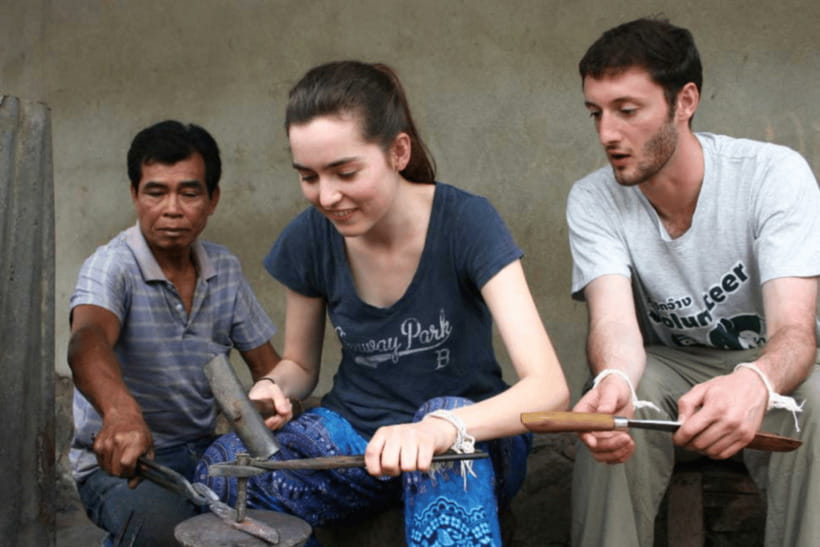
Steel gets a second life here. This hands-on Luang Prabang workshop lets you turn raw metal into a one-of-a-kind Lao-style survival knife, guided through heating, forging, cooling, and finishing. I like the small group limit of just two participants, which gives you plenty of time at the forge, and I like that you take home something useful rather than a forgettable souvenir.
The main catch is practical: a handmade knife can create trouble on later transport. One participant found that kitchen knives were allowed on a flight but were confiscated and discarded at Luang Prabang’s high-speed train station. I would plan your onward journey before booking, especially if you expect to leave Laos by train.
This is a one-day activity priced at $100 per person. The advertised class lasts four hours, though the work may finish sooner, with one pair completing two knives in about three hours. Materials, forge, tools, instruction, and lunch are included.
In This Review
- Key points to know before you book
- Starting at the Laos SPIRIT showroom
- Turning an old shock absorber into a Lao knife
- The nine-stage process, from heat to finished blade
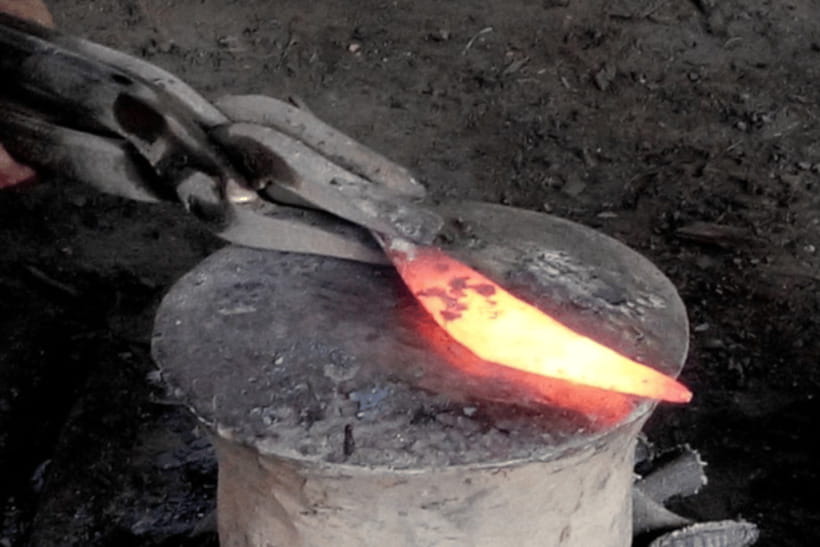
- Heating the metal
- Forging the shape
- Cooling the blade
- Finishing your creation
- Why the two-person format matters
- Lunch and the shape of the day
- Is $100 a fair price?
- Who will enjoy this workshop most?
- Booking flexibility and languages
- Should you book the DIY Lao Knife Workshop?
- FAQ
- How long does the DIY Lao Knife Workshop last?
- How much does the workshop cost?
- What is included in the workshop?
- Where does the activity start and finish?
- What languages are available?
- Can children join the workshop?
Key points to know before you book
- You make the knife from start to finish: The work covers heating, forging, cooling, and finishing rather than simple decoration.
- The material may be recycled: The knife can begin as an old shock absorber, giving the project a practical reuse angle.
- The class is very small: With only two participants, you get direct guidance and do not wait behind a large group.
- The finished knife goes home with you: Your final piece is personal, functional, and different from a factory souvenir.
- Lunch is included: The food makes the half-day work session easier to fit into a full Luang Prabang schedule.
- Plan transport carefully: A knife may fly with you, but it cannot be taken on the high-speed train from Luang Prabang according to the practical warning provided.
Starting at the Laos SPIRIT showroom
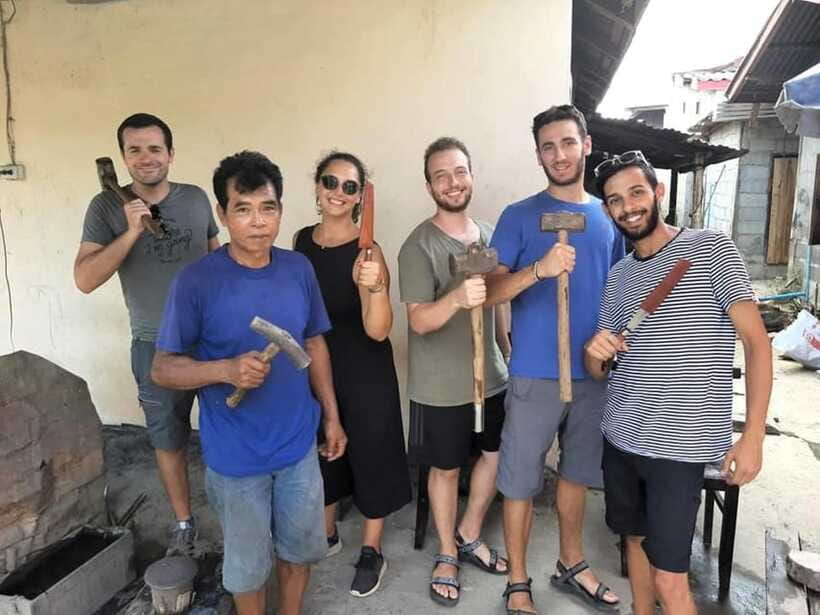
Your day begins at the Laos SPIRIT showroom, which serves as both the meeting point and the return point. This keeps the arrangement simple. You do not need to manage several pickup locations or find your way to a remote village workshop based on the information available.
The class itself takes place in Luang Prabang. The schedule is listed as a four-hour session, so you should keep at least half a day free. Since the work has several stages, the final timing may depend on how quickly you and the other participant handle the metal.
The two-person limit is one of the strongest parts of the setup. Knife-making involves heat, tools, and repeated hands-on work. A small class means the instructor can watch your technique closely and help you move through each stage without a crowd around the forge.
The guide can teach in English, French, Laothian, or Thai. That matters here because clear instructions are important when you are working with hot metal. The activity is open to beginners, but it is not suitable for children under 16.
More things to do in Luang Prabang:
- Luang Prabang: Cruise to Pak Ou Caves & Kuang Si Waterfalls
★ 5.0 · 1,769 reviews - Luang Prabang: Cruise to Pak Ou Caves & Kuang Si Waterfalls
★ 4.8 · 1,360 reviews - Half Day Mekong Cruise to Pak Ou Caves (Morning / Afternoon)
★ 4.6 · 290 reviews
Turning an old shock absorber into a Lao knife
The most unusual detail is the starting material. The finished blade may come from an old shock absorber, which gives the workshop a strong sense of reuse. You are not simply choosing a blade shape from a catalog. You are helping change an everyday piece of discarded metal into a working object.
That material also gives the experience a good cultural and practical angle. Lao knives are linked with daily work and outdoor use, not just display. The workshop lets you take part in that tradition through the making process, while the recycled steel keeps the project grounded in resourcefulness.
You should not expect a polished retail product to appear immediately. The appeal is in seeing the metal change under heat and pressure. The rough beginning is part of the point. Your knife will carry the marks of your own decisions and the instructor’s guidance.
The exact shape, handle details, and finishing options are not specified, so I would avoid booking with a fixed picture of the final knife in mind. You are promised a Lao-style survival knife and a one-of-a-kind creation, but the final appearance will depend on the work completed during the session.
The nine-stage process, from heat to finished blade
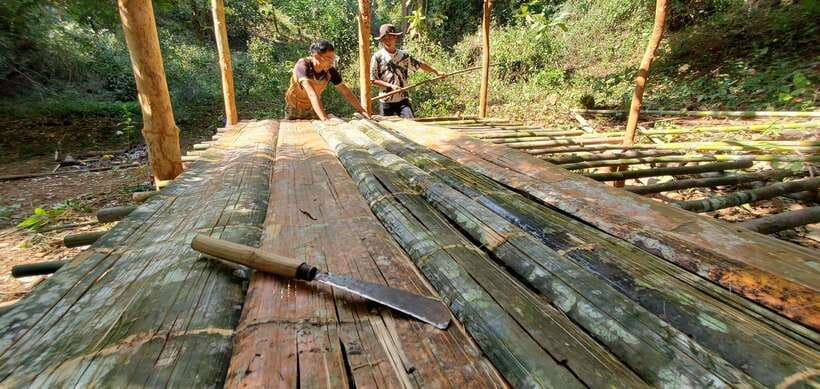
The class follows a nine-step knife-making process. The supplied details identify the major jobs as heating, forging, cooling, and finishing, but they do not name every individual stage. That is useful to know because you should expect a working class, not a quick demonstration.
Heating the metal
The process starts at the forge. You learn how the metal is prepared for shaping through heat, under the instructor’s direction. The forge and all required tools are included, so you do not need any previous equipment or knife-making experience.
This first stage sets the pace for the day. You will spend time watching the metal and following instructions rather than rushing through a craft souvenir activity. Since the class is limited to two people, the instructor can help you understand when and how the steel is ready for the next step.
A completely different kind of day:
- Luang Prabang: UNESCO World Heritage City Highlights Tour
★ 4.6 · 201 reviews - Luang Prabang: Afternoon Kuang Si Waterfalls & Sunset Cruise
★ 4.6 · 158 reviews - Luang Prabang: Evening Cooking Class & Local Baci Ceremony
★ 4.9 · 151 reviews - Luang Prabang: Kayak Tour to Pak Ou Caves
★ 4.4 · 115 reviews
Forging the shape
Forging is where the raw piece begins to look like a knife. You work the heated metal into form, following the Lao-style design taught in the workshop. The activity is described as suitable for beginners as well as people who already enjoy making knives, so you do not need to arrive with specialist skills.
The work is hands-on, but it is guided. That distinction matters. You are not left alone with a forge and a heavy tool, and you are not merely standing at the side while someone else makes the knife for you.
The precise tools and techniques are not listed, so I would expect instruction rather than a detailed technical course in metallurgy. If your goal is a professional blacksmithing qualification, this short session will not be that. If your goal is to understand the basic process and make one personal knife, the format fits much better.
Cooling the blade
Once the shape has been worked, cooling becomes part of the process. The description specifically includes cooling, so the class covers more than simply bending hot steel into a rough outline.
This stage gives the activity a useful rhythm. You move from heat and force to control and patience. The instructor’s presence remains important, and the small class size helps keep the process manageable.
Finishing your creation
The final work brings the knife closer to its finished form. Finishing is included in the stated nine-step process, and this is where your piece becomes something you can take away and remember the day by.
The workshop promises a personalized knife, though the available details do not spell out every finishing choice. You should see the result as a handmade Lao-style survival knife rather than a perfectly uniform factory blade. Small variations are part of owning something made during a single workshop.
One useful detail is the speed. Two knives were completed in roughly three hours, even though the class is scheduled for four. That suggests the advertised duration gives you breathing room for instruction, lunch, and the pace of the work. Still, I would keep the full four hours open rather than arranging a tight connection afterward.
Why the two-person format matters
A class for only two participants changes the feel of the experience. You get direct time with the instructor, and the pace can stay focused on your own knife. For a task involving heat and metal, that is more valuable than a large group atmosphere.
It also makes this a good choice for two people traveling together. You can work side by side, compare the progress of your blades, and still receive individual help. The small format may suit a couple, friends, or a parent and older teenager, provided the participant is at least 16.
The tradeoff is that this is not a lively group social activity. If you enjoy meeting a dozen new people during a craft class, the two-person limit will feel quiet. I see that as a benefit for the work itself, but it is worth matching the format to your travel style.
Lunch and the shape of the day
Lunch is included, which is a welcome practical touch. A forge session can take more energy than a standard sightseeing stop, so having food provided means you do not need to interrupt the activity to find a restaurant.
The information does not specify the menu, dietary options, or exact lunch timing. If you have dietary restrictions, ask the provider before the day of the class. I would also wear clothing and shoes suited to a practical workshop, though no specific dress code is provided.
The activity is valid for one day, with starting times depending on availability. You will need to check the schedule for the date you want. Since the workshop returns to the Laos SPIRIT showroom, it should be easy to place before or after other plans in Luang Prabang, as long as you leave enough time for the full session.
Is $100 a fair price?
At $100 per person, this is not a cheap craft demonstration. The value comes from the amount of personal work included. You receive access to the forge, metal, and tools, plus instruction through the full making process, lunch, and a finished knife to take home.
For me, the two-person limit is the key reason the price can make sense. You are paying for concentrated instruction and an object made during the session, not just admission to watch a blacksmith. If you have always wanted to try forging, the experience offers more substance than buying a ready-made souvenir.
The value is weaker if you only want a Lao knife and do not care how it is made. You may find a finished knife elsewhere for less than $100, though it will not carry the same personal connection or workshop memory.
You should also factor in possible transport costs or inconvenience after the class. The knife is your responsibility once you leave. A verified practical warning says knives were accepted for air travel but confiscated at the high-speed train station in Luang Prabang. If you are taking that train, this workshop could leave you with an item you cannot bring aboard.
That issue is not a minor footnote. I would check your exact departure plans before paying, and I would ask Laos SPIRIT about safe transport or shipping options if you will not fly.
Who will enjoy this workshop most?
I would recommend it to adults and older teenagers who like practical activities, local crafts, and souvenirs with a story. It is especially suitable if you prefer making something over taking another guided walk through town.
You will get the most from it if you enjoy patient, hands-on work. The class is not designed as a passive cultural presentation. You are there to handle the process and leave with the result.
It also suits travelers with a free half-day in Luang Prabang who want an activity outside the usual temple and market circuit. The workshop connects a useful Lao object with local making skills, while the small group keeps the experience personal.
I would hesitate to recommend it to anyone under 16, anyone uncomfortable around a forge, or anyone whose travel plans depend on taking a high-speed train with the finished knife. The age rule is clear, and the transport warning deserves serious attention.
Booking flexibility and languages
The activity offers free cancellation up to 24 hours before the start time for a full refund. You can also reserve now and pay later, which helps if your Luang Prabang schedule is still changing.
Guidance is available in English, French, Laothian, and Thai. The small group is limited to two participants. Check the available starting time for your date, since the activity is listed as a one-day experience rather than a fixed daily departure.
These policies are useful, but I would give the transport question priority. Flexible booking cannot solve the problem of arriving at the train station with a knife that officials will not allow aboard.
Should you book the DIY Lao Knife Workshop?
Book it if you want a real hands-on project, value direct instruction, and like the idea of carrying home a knife you helped make from recycled metal. The $100 price is reasonable for a private-feeling, two-person session with tools, materials, lunch, and a finished creation included.
Skip it if you want a quick souvenir, dislike hot-metal work, or plan to take the high-speed train after the class. For everyone else, this is one of the more personal ways to spend half a day in Luang Prabang. Just solve the transport question before you light the forge.
FAQ
How long does the DIY Lao Knife Workshop last?
The class is scheduled for four hours. Two knives were completed in about three hours during one session, but you should keep the full four-hour period available.
How much does the workshop cost?
The price is $100 per person.
What is included in the workshop?
The fee includes the forge, metal, tools, and everything needed to make the knife. Lunch is also included.
Where does the activity start and finish?
The meeting point is the Laos SPIRIT showroom. The activity returns to the Laos SPIRIT showroom after the class.
What languages are available?
Live guidance is available in English, French, Laothian, and Thai.
Can children join the workshop?
No. The activity is not suitable for children under 16.
Just added in Luang Prabang
- The Namkhan – Traditional Lao Bamboo Weaving★ 5.0 · 4 reviews
- Unwind with a Sunset Cruise on the Mekong River★ 5.0 · 4 reviews
- Night Bus to Huay Xai, Chiang Rai, Thailand – Hotel pickup★ 3.0 · 2 reviews
- Sunset Cruise in Luang Prabang with Live Performance★ 4.5 · 3 reviews
- The Namkhan – 90 Minutes Private Signature Scrub and Massage★ 5.0 · 2 reviews
- Private Tour: Half-Day City Tour of Luang Prabang★ 4.5 · 4 reviews
- Trek to Tad Sae Waterfalls, Local Village★ 4.5 · 2 reviews
- Private Luang Prabang City Tour★ 5.0 · 3 reviews
Luang Prabang Tours, compared.


Half Day Mekong Cruise to Pak Ou Caves (Morning / Afternoon)
Read our review →


Browse the lists this tour appears in